
Cholesterol, ApoB and the lipoprotein profile
“High cholesterol” is one of the most misunderstood results in modern medicine – sometimes overblown, sometimes overlooked. What matters most for your health isn’t total cholesterol or even LDL-C alone. It’s the number of cholesterol-carrying particles in your blood (measured as ApoB), how big those particles are (called phenotype A or B), Lp(a) (a genetic risk particle), and inflammation markers like hs-CRP, homocysteine, and fibrinogen.
- ApoB (a marker of particle count) matters more than LDL-C alone
- Small, dense LDL particles (phenotype B) are much more dangerous
- Lp(a), hs-CRP, homocysteine, and fibrinogen are often skipped but clinically important
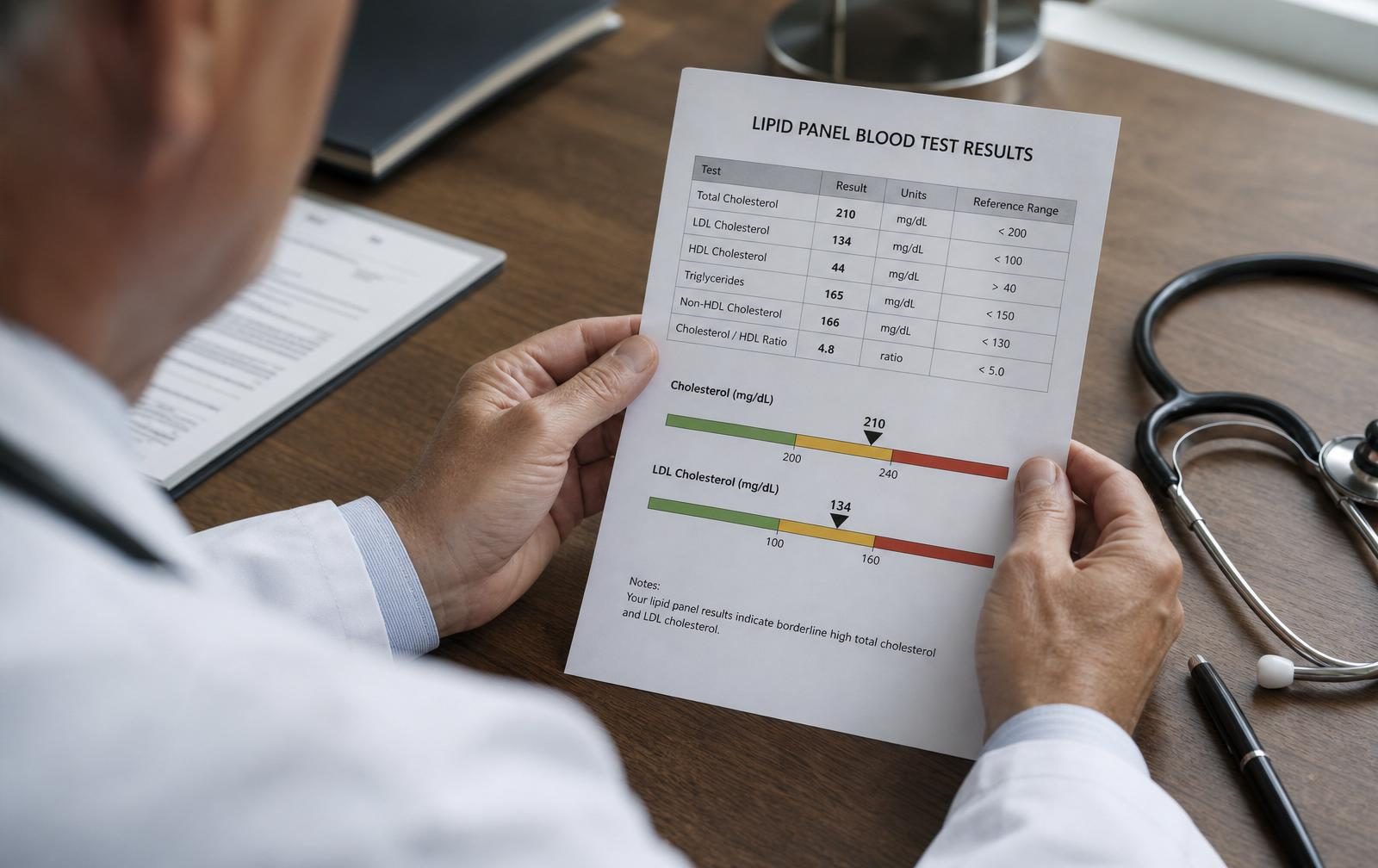
What cholesterol is – and why the standard test misses half the picture
Cholesterol is not a “bad substance.” It’s the raw material for every cell membrane, for hormones like testosterone, estrogen, and cortisol, and for vitamin D. Your liver makes about 80% of the cholesterol in your blood; only about 20% comes from food.
Cholesterol doesn’t dissolve in water, so it travels through the blood inside carrier particles called lipoproteins – LDL, VLDL, IDL, HDL, and Lp(a). Every one of these particles carries a protein called apolipoprotein B (ApoB) on its surface, except HDL, which carries ApoA instead. Measuring ApoB tells you exactly how many artery-clogging particles you have – something the standard “LDL cholesterol” number (measured in weight) cannot show.
Two people can have the same LDL-C (say 3.5 mmol/L) but very different risk. One may have large, fluffy LDL particles in small numbers (phenotype A – lower risk). The other may have many small, dense LDL particles (phenotype B – higher risk). Same amount of cholesterol, very different risk.
Warning signs and a higher-risk profile
- Trig/HDL ratio above 1.5 – an indirect sign of phenotype B (small, dense LDL) and insulin resistance
- Family history of an early heart attack (before 55 in men, before 65 in women)
- Diagnosed familial hypercholesterolemia (FH – an inherited condition that causes very high cholesterol)
- Xanthelasma (yellow patches on the eyelids) or a gray ring around the cornea before age 50
- Thickening of the arteries seen on a carotid or abdominal ultrasound
- Metabolic syndrome: extra belly fat, high blood pressure, and insulin resistance together
- An ongoing inflammatory condition (autoimmune disease, gum disease, inflammatory bowel disease)
- Smoking and chronic stress – both speed up atherosclerosis (plaque buildup) even with “normal” LDL
Why ApoB matters more than LDL-C
A plaque starts to form when a particle carrying ApoB (a protein tag on artery-clogging particles) gets stuck in the artery wall. What matters is how many particles are knocking at the door – not how many grams of cholesterol they carry. Every LDL, VLDL, IDL, and Lp(a) particle carries exactly one ApoB molecule, so counting ApoB gives you a direct particle count.
Large studies (Sniderman, Circulation 2019; INTERHEART) show that ApoB predicts heart attacks and strokes more accurately than LDL-C. This matters most when the two disagree: someone with “normal” LDL-C but high ApoB is still at high risk.
Particle size: phenotype A vs. phenotype B
- Phenotype A – larger, fluffier LDL particles, fewer of them, lower risk
- Phenotype B – small, dense LDL particles (sdLDL), more of them, higher risk
- Phenotype B tends to appear with insulin resistance, high triglycerides, and low HDL
- A Trig/HDL ratio above 1.5 (mmol/L) or 3.5 (mg/dL) is a strong sign of phenotype B
- Small, dense LDL particles slip into the artery wall more easily and oxidize (break down chemically) more easily too – both make them more dangerous
Four pillars for a healthier lipid profile
A statin (cholesterol-lowering drug) is just one tool. Lifestyle works alongside it and directly changes particle number, particle size, and inflammation.
Nutrition
Cut back on refined carbs and sugary drinks – the biggest drivers of high triglycerides and phenotype B (small, dense LDL particles). Eat more fiber (30+ g a day), omega-3 fats, and monounsaturated fats (olive oil, avocado, nuts). Losing 5–10% of your body weight often lowers ApoB (particle count) by 15–25%.
Insulin sensitivity
Phenotype B and high triglycerides are usually caused by insulin resistance (when cells respond poorly to insulin). Lowering insulin levels – through an 8–10 hour eating window, strength training, and good sleep – can improve your lipid profile more than medication alone.
Supplements that can support your lipids and blood vessels
Supplements don’t replace statins (cholesterol-lowering drugs) when your doctor says you need one. But several can support healthy lifestyle changes and improve markers that statins don’t touch.
- Omega-3 (EPA/DHA fatty acids, 2–4 g/day) – lowers triglycerides by 20–30% and reduces inflammation
- Berberine – lowers LDL-C and ApoB (particle count) by about 15% and improves insulin sensitivity; check for drug interactions first
- Red yeast rice (contains monacolin K) – works like a statin; don’t combine it with an actual statin
- B12, folate (in methyl form), B6, and betaine (TMG) – lower homocysteine (an amino acid that can damage blood vessels)
- Vitamin K2 (MK-7) – helps direct calcium into bones instead of arteries (best paired with vitamin D)
- CoQ10 (ubiquinol) – supports cell energy production, especially if you take a statin
- Nattokinase – may lower fibrinogen (a blood-clotting protein) and help break down clots (research is still ongoing)
- Plant sterols and fiber (such as psyllium) – reduce how much cholesterol your gut absorbs
Fasting and your lipid profile
Time-restricted eating (eating only within a set window each day) and periodic fasting can lower triglycerides, shift LDL toward the safer phenotype A, and lower ApoB. This likely happens because fasting improves insulin sensitivity (how well your cells respond to insulin).
In a 2019 study (Tinsley et al., Am J Clin Nutr), an 8-hour eating window combined with strength training improved the lipid profile and body composition in adults with excess weight, including triglycerides and fat mass.
Fasting is not right for everyone. Avoid it during pregnancy or breastfeeding, if you have a history of an eating disorder, or if you take certain medicines (like insulin or sulfonylureas) without medical supervision.
Expanded lipid panel – what to ask for
- ApoB (a protein that marks each artery-clogging particle) – a direct particle count (target under 0.9 g/L; under 0.65 if you’re high risk)
- Lp(a) (a genetic, LDL-like particle) – test at least once in your life (target under 30 mg/dL / 75 nmol/L)
- LDL-C, HDL-C, triglycerides, total cholesterol (the standard panel)
- Trig/HDL ratio – an indirect sign of phenotype B (small, dense LDL) and insulin resistance
- Non-HDL cholesterol – all artery-clogging particles combined
- hs-CRP (a sensitive marker of inflammation) – vascular inflammation (target under 1 mg/L)
- Homocysteine (an amino acid that can damage blood vessels; target under 8 μmol/L)
- Fibrinogen (a blood-clotting protein; target under 3.5 g/L)
- Fasting insulin and HOMA-IR (a score that estimates insulin resistance) – the root cause of phenotype B
- Thyroid tests (TSH, free T3) – an underactive thyroid raises LDL
- Vitamin D and ferritin (a marker of iron stores) – for overall context
- Coronary artery calcium score (CAC – a scan that measures calcium buildup in heart arteries) from age 40 – shows plaque directly
Go deeper: lipidology and cardiovascular webinars
Recorded webinars on ApoB, lipoproteins and cardiovascular risk assessment – with Dr Saadi.
Lipiidiprofiili sihttasemed
Sihtväärtused sõltuvad kardiovaskulaarsest riskist (ESC 2019, EAS 2022)
| Marker | Madal risk | Mõõdukas / kõrge risk | Väga kõrge risk |
|---|---|---|---|
| LDL-kolesterool | < 3,0 mmol/l | < 2,6 mmol/l | < 1,4 mmol/l |
| ApoB | < 100 mg/dl | < 80 mg/dl | < 65 mg/dl |
| Triglütseriidid | < 1,7 mmol/l | < 1,5 mmol/l | < 1,5 mmol/l |
| HDL-kolesterool (M / N) | > 1,0 / > 1,2 mmol/l | sama | sama |
| Lp(a) | < 30 mg/dl (< 75 nmol/l) | sama | sama |
| Non-HDL kolesterool | < 3,8 mmol/l | < 3,4 mmol/l | < 2,2 mmol/l |
| Homotsüsteiin | < 10 µmol/l | < 10 µmol/l | < 10 µmol/l |
LDL-kolesterool
- Madal risk
- < 3,0 mmol/l
- Mõõdukas / kõrge risk
- < 2,6 mmol/l
- Väga kõrge risk
- < 1,4 mmol/l
ApoB
- Madal risk
- < 100 mg/dl
- Mõõdukas / kõrge risk
- < 80 mg/dl
- Väga kõrge risk
- < 65 mg/dl
Triglütseriidid
- Madal risk
- < 1,7 mmol/l
- Mõõdukas / kõrge risk
- < 1,5 mmol/l
- Väga kõrge risk
- < 1,5 mmol/l
HDL-kolesterool (M / N)
- Madal risk
- > 1,0 / > 1,2 mmol/l
- Mõõdukas / kõrge risk
- sama
- Väga kõrge risk
- sama
Lp(a)
- Madal risk
- < 30 mg/dl (< 75 nmol/l)
- Mõõdukas / kõrge risk
- sama
- Väga kõrge risk
- sama
Non-HDL kolesterool
- Madal risk
- < 3,8 mmol/l
- Mõõdukas / kõrge risk
- < 3,4 mmol/l
- Väga kõrge risk
- < 2,2 mmol/l
Homotsüsteiin
- Madal risk
- < 10 µmol/l
- Mõõdukas / kõrge risk
- < 10 µmol/l
- Väga kõrge risk
- < 10 µmol/l
Väga kõrge risk = varasem infarkt/insult, diabeet + kahjustus, krooniline neerukahjustus, familiaalne hüperkolesteroleemia. ApoB on täpsem kui LDL üksi.
Frequently asked questions
Go deeper: related materials
Related topics
Metabolic health is interconnected – explore the other deep-dives:
Insulin resistance
The root of metabolic disease – 5–10 years before diabetes appears.
ReadOverweight
Why calorie counting fails – hormones, insulin, leptin and adipose tissue.
ReadVagus nerve
The rest-and-repair system – digestion, heart, inflammation, stress.
ReadSleep
The foundation of metabolic health – hormones, cortisol, insulin, brain recovery.
ReadChronic inflammation
The ‘silent fire’ behind cardiovascular disease, diabetes and autoimmunity.
ReadLow-carb and keto
Carbohydrate restriction – IR, T2D, fatty liver, metabolic syndrome.
ReadTeaduslikud allikad
- Mach F et al. 2019 ESC/EAS Guidelines for the management of dyslipidaemias. European Heart Journal, 2020. doi.org/10.1093/eurheartj/ehz455
- Sniderman AD et al. Apolipoprotein B Particles and Cardiovascular Disease: A Narrative Review. JAMA Cardiology, 2019. doi.org/10.1001/jamacardio.2019.3780
- Kronenberg F et al. Lipoprotein(a) in atherosclerotic cardiovascular disease and aortic stenosis (EAS Consensus Statement). European Heart Journal, 2022. doi.org/10.1093/eurheartj/ehac361
- Bhatt DL et al. Cardiovascular Risk Reduction with Icosapent Ethyl for Hypertriglyceridemia (REDUCE-IT). NEJM, 2019. doi.org/10.1056/NEJMoa1812792
- Jenkins DJA et al. Effects of a Dietary Portfolio of Cholesterol-Lowering Foods vs. Statin. JAMA, 2003. doi.org/10.1001/jama.290.4.502
- Ference BA et al. Low-density lipoproteins cause atherosclerotic cardiovascular disease. 1. Evidence from genetic, epidemiologic, and clinical studies (EAS Consensus). European Heart Journal, 2017. doi.org/10.1093/eurheartj/ehx144
- Sacks FM et al. Dietary Fats and Cardiovascular Disease (AHA Presidential Advisory). Circulation, 2017. doi.org/10.1161/CIR.0000000000000510
- Cannon CP et al. Ezetimibe added to Statin Therapy after Acute Coronary Syndromes (IMPROVE-IT). NEJM, 2015. doi.org/10.1056/NEJMoa1410489
Dr Sergey Saadi – expert in advanced lipidology and metabolic health
Dr Sergey Saadi is a physician with over 15 years of clinical practice.
- Clinical approach: ApoB + Lp(a) + hs-CRP + homocysteine + fibrinogen – not just LDL-C
- Regular speaker in media and in clinician training
- Author of “Dangerous secrets of blood sugar” (Varrak)
Want to know your real cardiac risk?
In the consultation we review your expanded lipid panel (ApoB, Lp(a), hs-CRP, homocysteine, fibrinogen), the CAC score and build an individual plan you can discuss with your GP and/or cardiologist.
Booking information and contactThis page is educational and general. It is not personal medical advice, a diagnosis or a treatment plan. Discuss changes with your doctor.